Fishing · Afternoon · Basic
Shore Fishing With Almost No Tackle
A stick, a length of line and a few hooks is a real fishing rig. What state agencies tell beginners to carry, how to rig it, and where to stand.
This is for educational purposes only. Not professional medical, electrical, or safety advice.
Warning
Leave the water immediately at the first sign of lightning. Keep control of the exposed hook when casting, and use pliers — not teeth — for split shot.
- 01
Carry real tackle — it beats improvising
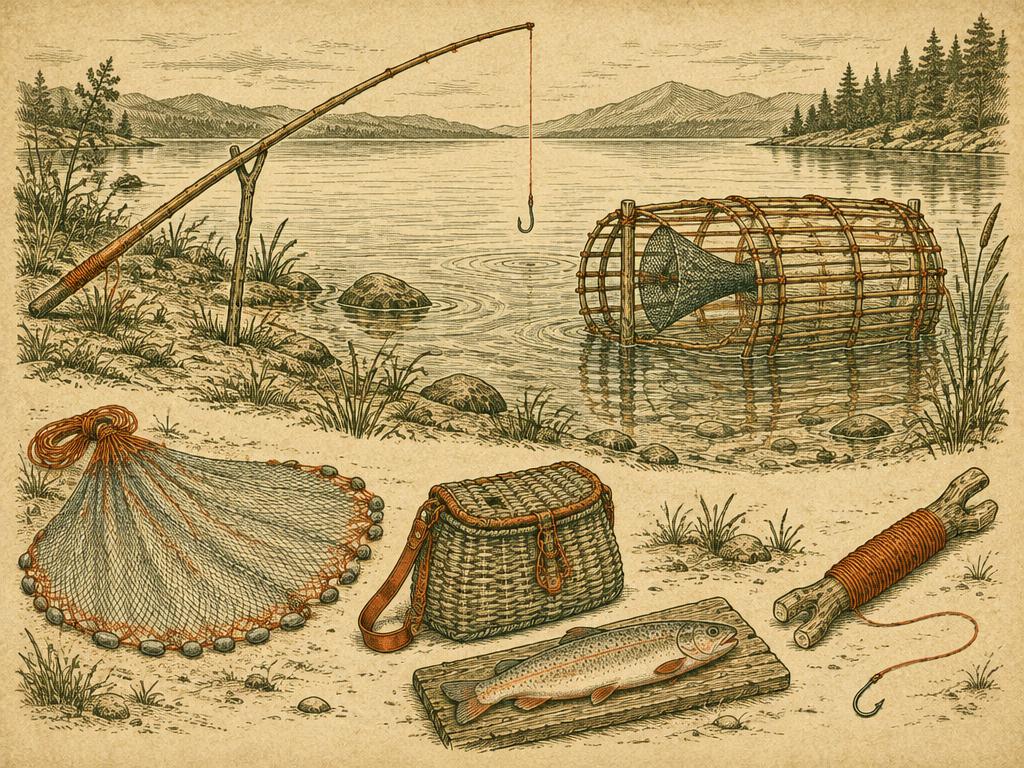
Minnesota DNR expressly allows a cane pole or long stick with line tied to the end for crappies and sunfish, and its beginner recommendation is 8-pound-test line with hooks in sizes 4–10 plus a hook, sinker and bobber. Natural bait such as nightcrawlers and minnows is on the same list. Carrying a small tin of hooks and a spool of line is far more reliable than carving thorn or bone hooks.
- 02
Tie the rig beginners are taught
New York's DEC illustrates a #6 or #8 long-shank hook tied with an improved clinch knot, baited, with a bobber adjusted so the hook hangs just above the bottom or just outside cover. The same page shows bottom rigs using a slip sinker, plus worm, doughball and minnow presentations.
- 03
Match line length to your pole
Illinois DNR's beginner guide recommends 6–10-pound-test line, and for a cane pole a line about the pole's length plus your own arm's length. Put a split-shot sinker roughly 6 inches above the hook. Use pliers to crimp split shot, not your teeth.
- 04
Stand where the fish actually are
Minnesota DNR points to shade and cover near logs, rocks and trees, and to deeper shore-accessible water near steep banks and inflows. In summer, try early morning and evening; as nearshore water warms, fish move deeper. There is no universal 'fish always bite at dawn' rule.
- 05
Get out when the weather turns
Minnesota DNR's instruction is blunt: never remain beside the water during lightning. Open water, a long pole and an open bank are exactly the combination you do not want in a storm.
- 06
Control the hook while you swing
Illinois DNR's casting safety guidance is to check the area behind and around you before you swing, and to keep control of the exposed hook. A hook in a shoulder on day one of an emergency is a bad trade.